Belief Is a Verb
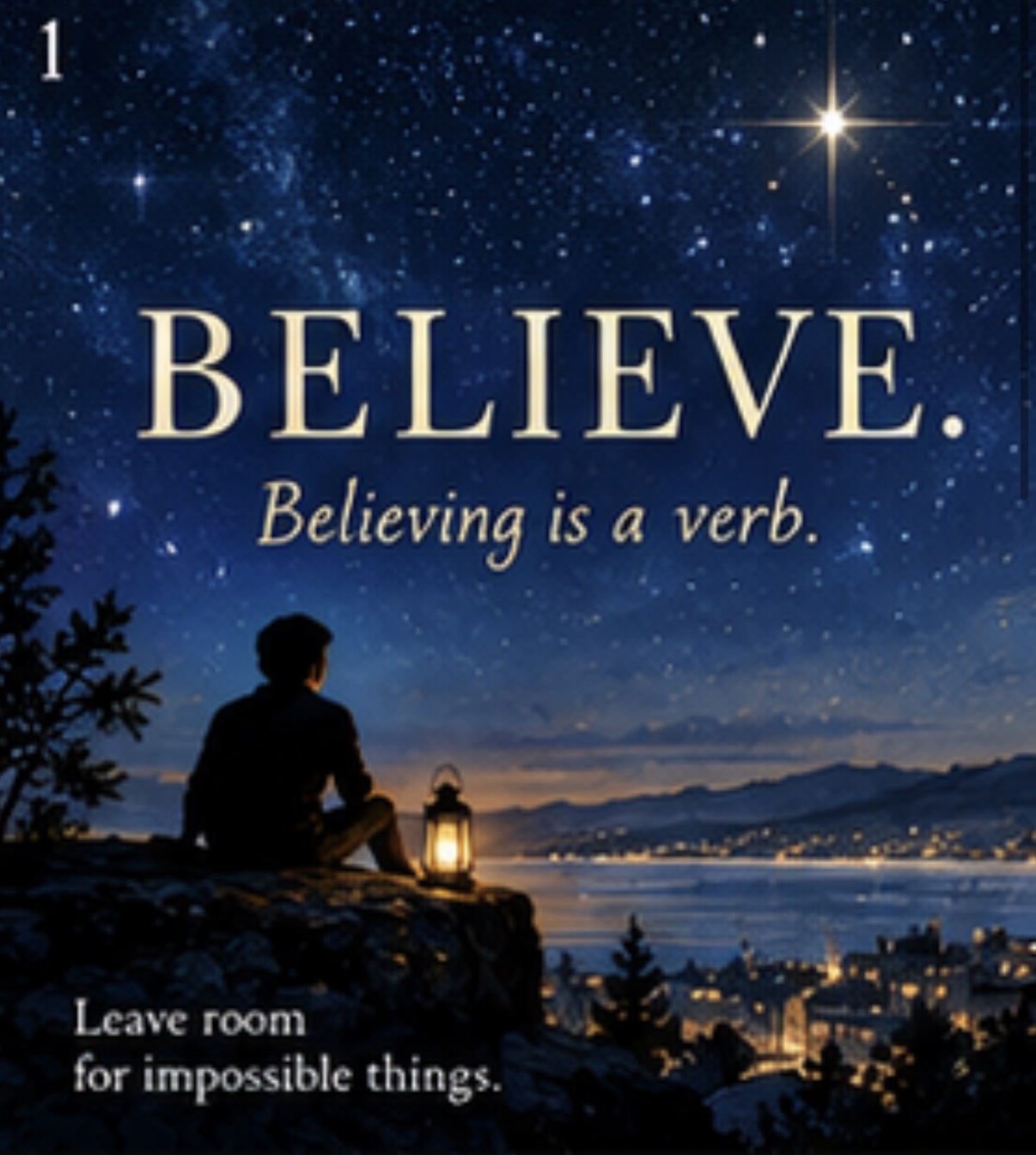
I feel like we are all taught belief is something you just have.
Like faith.
Like magic.
Like some small golden thing tucked safely inside you that either survived childhood - or didn’t.
I don’t think that way anymore.
I think belief is a practice an opposite action.
An art even.
And perhaps that is why we need it now more than ever before.
But my mind also drifts to Peter Pan lately and JM Barrie’s quote “The reason birds can fly and we can’t is simply that they have perfect faith, for to have faith is to have wings.” So is there a magic middle path in the practice?
Can we fly too or whatever that “believed” impossible obstacle may be?
And that wonder idea that somewhere between faith and trust and a little bit of fairy dust, gravity might loosen its hold on us.
As children, we understood this instinctively - like those birds…
Of course there were fairies.
Of course there was Neverland.
Of course there was a second star to the right and somewhere beyond morning, if only we could remember how to get there.
And perhaps most importantly—
of course we could fly.
Then we grew up.
And somewhere along the way, belief became something we thought we needed to prove.
We learned gravity.
We learned endings.
We learned loss.
We learned all the terrible things that can happen between one morning and the next.
And perhaps we began to mistake knowing what can go wrong for knowing what will.
I know I did.
Because believing when the sky is clear is easy.
Believing when you already know the ending isn’t really belief at all.
The practice begins somewhere else.
In the long night.
In the distance between what you know and what you desperately wish you knew.
In loving someone beneath a sky you cannot protect them from.
In standing at the edge of everything your frightened mind can imagine and saying—
yes.
I see all of that.
And I will leave room for possibility too.
That has been one of the strangest evolutions of my life.
I once thought belief required certainty.
Now I think certainty may actually be its opposite.
Because belief says—
I don’t know.
I don’t know what happens next.
I don’t know how the story ends.
I don’t know whether the thing I am hoping for is waiting somewhere beyond the horizon.
But I know fear doesn’t get to be the only storyteller.
And maybe this is where I understand Peter Pan differently now too.
Because perhaps the magic was never really that Peter could fly.
Perhaps the magic was that for one extraordinary moment, the others believed they could too.
Not because gravity disappeared.
But because something became possible that moments before they could not imagine.
There is something about that I understand now in a way I couldn’t as a child.
Belief does not require the absence of gravity.
It asks what we will do while gravity is still pulling at our feet.
And just like the powerful of doubt when tinkerbell could no longer fly - it wasn’t simply enough to say “I believe - I believe - you had to clap your hands as you said it”
So I practice.
I practice believing when I wake up.
I practice when the old gatekeeper begins checking every door.
I practice when the evidence is incomplete.
I practice when somebody I love is impossibly far away.
I practice by lighting a candle.
By writing a name.
By learning words.
By looking at the moon.
By making plans for ordinary Tuesdays in a future I cannot guarantee.
By loving someone now instead of withholding love until the universe gives me assurances.
And Perhaps that is what belief is?
Not pretending there isn’t a storm.
Not denying gravity—
but remembering that somewhere in us there are still wings.
Not demanding proof that morning is coming—
but keeping watch for the first thin line of light anyway.
And maybe this is what growing up was supposed to teach me about all those stories I loved as a boy.
Maybe growing up was never supposed to mean becoming too wise for magic.
Maybe it meant discovering what magic costs.
To believe after disappointment.
To trust after loss.
To love after grief.
To leave the window open even after you have learned how very dark the night can become.
Because perhaps faith and trust were never instructions for children learning how to fly.
Perhaps they were instructions for adults learning how to remain open even after - especially after - just how hard life can push you down and try to clip your wings.
Open to love.
Open to wonder.
Open to another ending.
Open to the possibility that this enormous, brutal, beautiful world has not finished surprising us yet.
And perhaps that is my favorite thing about belief now.
It doesn’t ask me to become the child I once was.
It asks the person I have become—
the one who knows about gravity,
the one who knows about storms,
the one who knows that some people leave,
that some prayers go unanswered,
that sometimes the thing we desperately wanted does not come—
to believe anyway.
Not blindly.
Not foolishly.
Not because I haven’t seen enough of the world.
But because I have.
So yes—
after all these years,
after everything I have seen,
after everything I know now that I did not know then—
I still believe.
Perhaps more deliberately than I ever have.
I still look for the second star.
I still leave room for impossible things.
I still light something in the darkness.
I still practice looking toward morning.
And every now and then,
when gravity feels particularly convincing,
I remind myself—
faith.
trust.
a little fairy dust.
and perhaps,
just perhaps,
we might still remember how to fly.
Because I know something now that I couldn’t have understood as a child:
belief isn’t something you either have or lose.
Believing is a verb. And life is a bit more magical when you leave space for those things you may have once judged as impossible. Believe.