God Is in the Rain
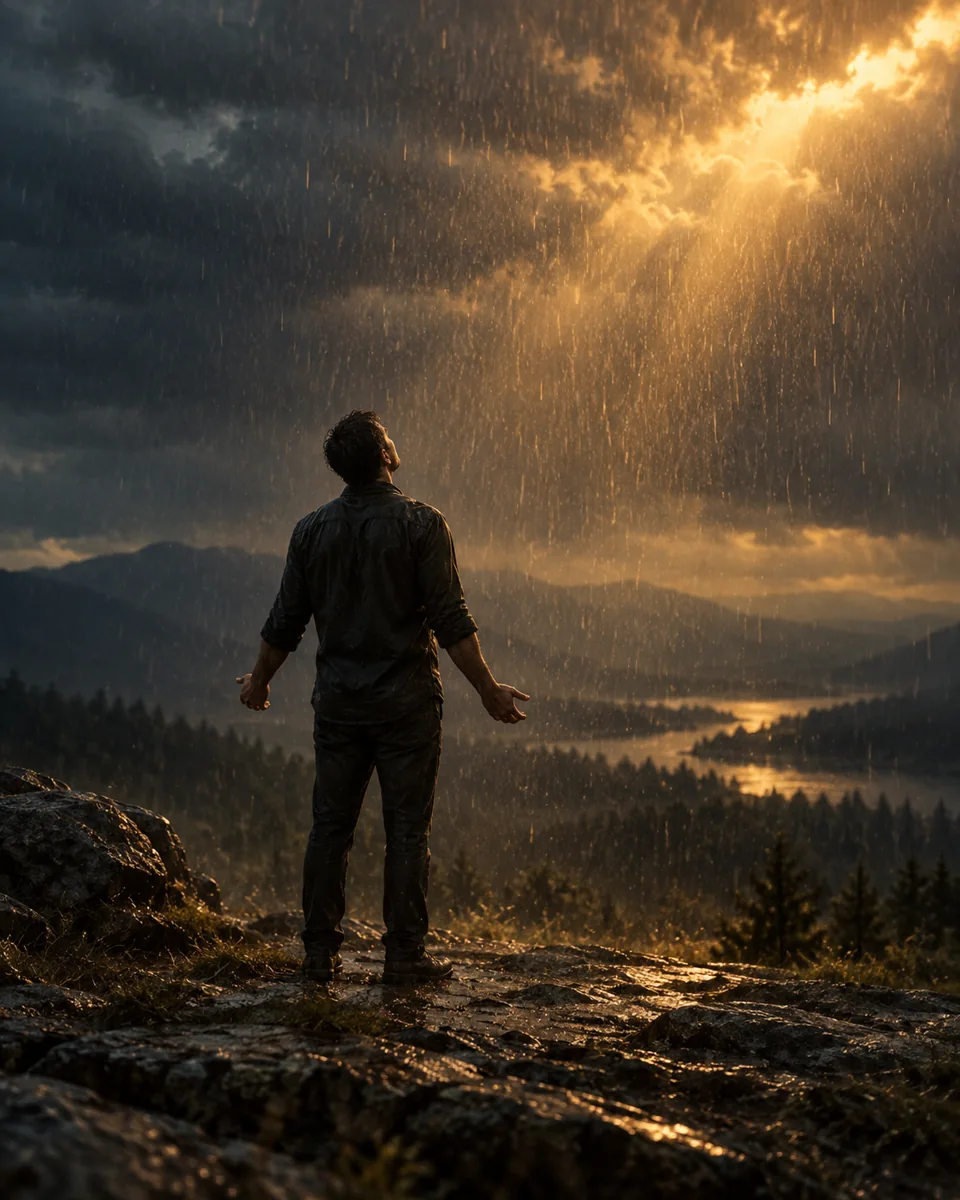
“God is in the rain.”
I wrote that once.
A lifetime ago, perhaps.
Or at least several versions of me ago.
Sweet, sweet rain—
how I’ve missed you.
At the time, I think I understood rain as renewal.
As cleansing.
As the sky opening itself over all the places in us that had become too dry—
the tired places,
the frightened places,
the places where something had stopped growing because it had forgotten what water felt like.
I had lived in Florida, where rain arrives like a declaration.
And I knew even then that rain was not innocent.
I had watched hurricanes take homes.
My homes.
Watched floodwater carry away not only walls and furniture, but photographs—
the small paper evidence that a life had happened before the water came.
There was one season when the storms took our electricity for almost two months.
My mother was staying with me then.
She had already disappeared deeply into the private weather of her illness.
We had covered the windows with plywood before the first hurricane.
When it passed, I tried to take the boards down.
But another hurricane came.
And after that, something inside her decided the plywood was the only thing keeping the next storm away.
If we removed it, she believed, another hurricane would come.
Perhaps even a tornado.
Again.
She would shake.
Wail.
Become completely overtaken by a terror no amount of reasoning could reach.
So I left the plywood where it was.
Because sometimes loving someone means understanding that what appears irrational from the outside is the final wall between them and an unbearable world.
But it was Florida.
The electricity was gone.
The windows were sealed.
The temperature climbed above one hundred degrees, and the humidity entered everything—
our clothes,
our beds,
our lungs.
The house held the heat like another illness.
And then, after more than a month without power, the rain came.
Not hurricane rain.
Not the kind that tears roofs from houses or sends families searching through floodwater for the remains of their lives.
One of those rare Florida rains that arrives at precisely the right temperature.
Cool enough to offer relief.
Warm enough that you can step beneath it without your body resisting.
The kind of rain you can bathe in.
So I went outside.
And then I noticed the neighbors emerging from their own dark houses.
One by one.
Standing beneath the same water.
Washing.
Laughing.
Looking toward one another with the quiet recognition of people who had survived the same heat and no longer needed to explain anything.
There are intimacies born from shared catastrophe that require no introduction.
Only a glance.
A smile.
The small astonishment of relief arriving from the sky.
And then my mother came outside.
The terrified mother.
The mother whose mind had told her that removing a piece of plywood could summon another storm.
She stepped into the rain.
It did not cause a tornado.
The sky did not punish her for leaving the shelter she had made.
She simply stood there—
and laughed.
Not the frantic or manic laughter I had come to recognize.
Something softer.
A laugh I had not heard in decades.
For one moment, the illness loosened its grip enough for something older to come through.
My mother.
Still there.
Standing in the rain.
I remember.
And afterward, she let me remove some of the plywood.
Not all at once.
Slowly.
One window.
Then another.
Until eventually the house could see outside again.
Until light entered the rooms that terror had kept covered.
And the rain continued to fall.
Perhaps that is why I have never needed rain to be innocent before I could call it healing.
I knew what storms could take.
But I had also watched one return my mother to me—
if only for the length of a rainfall.
And then there was Los Angeles—
where people step outside to witness rain as though something miraculous has occurred.
Perhaps it has.
There has always been something sacred to me about standing beneath a storm.
About surrendering to what cannot be controlled.
About letting the sky touch every part of me without asking which parts deserved it.
But lately my heart has been leaning toward Gaza.
They say the rains are arriving.
And I have been watching the children play.
Children who know the sound of things falling from the sky that are not rain.
Children whose bodies have learned to distinguish weather from warning.
And still—
when the rain comes,
some of them run toward it.
They lift their faces.
Open their mouths.
Jump into puddles.
Laugh with their entire bodies.
For one impossible moment,
the rain becomes rain again.
And perhaps that should be enough.
Perhaps I should let the image remain beautiful.
But beauty has never asked me to look away from the rest of the truth.
Because rain in Gaza is not only laughter.
It finds the holes in tents.
It soaks blankets that may have nowhere warm to dry.
It turns dust and ash into mud.
It gathers beneath the bodies of people who have already lost walls, roofs, windows—
all the ordinary boundaries that once kept weather outside.
The rain nourishes.
The rain heals.
The rain destroys.
The same water that coaxes green from the earth can take the earth out from beneath your feet.
The same storm that makes one child dance can leave another shivering through the night.
And perhaps this is where my understanding of sacredness has changed.
I used to think something sacred was something good.
Gentle.
Healing.
A light arriving to make the darkness disappear.
Now I wonder if the sacred is not always so easily divided.
Perhaps sacredness does not mean harmless.
Perhaps it means something powerful enough to hold creation and destruction—
joy and grief,
terror and wonder,
the child laughing in the puddle
and the mother trying desperately to keep his bed dry—
without asking us to deny either one.
I think of my favorite Gazan sun beneath that sky.
The rain touching the city where he wakes.
The same element that may fall against my own window traveling through a world of borders as though borders do not exist.
No passport.
No checkpoint.
No permission required.
Only water returning to earth.
And for a moment, the distance becomes something my heart can cross.
Rain here.
Rain there.
My hand against the window.
His face somewhere beneath the same enormous sky.
Perhaps that is where my heart leans.
Not toward the fantasy that love can stop the storm.
Not toward the belief that suffering must contain some secret gift.
Not toward the terrible habit we have of turning survival into evidence that what happened was necessary.
Some storms are simply storms.
Some destruction should never have happened.
Some children should know rain only as weather.
And I do not need to call devastation sacred in order to recognize something sacred inside the bodies that continue reaching for joy.
The rain does not redeem the ruin.
It does not wash Gaza clean of what has happened.
It cannot return the martyred.
It cannot rebuild a home.
It cannot make a tent into one.
But still—
a child lifts his face.
Still—
someone places a container beneath the water.
Still—
a seed receives what it needs.
Still—
somewhere inside a body surrounded by devastation,
laughter remembers the way out.
Maybe that is why the children playing in the rain move me so deeply.
They are not telling us everything will be okay.
They are not symbols created to make suffering more beautiful from a distance.
They are children.
Wet.
Cold, perhaps.
Laughing anyway.
Not because they do not understand destruction.
Not because the rain has healed what happened.
But because joy sometimes arrives before the mind has time to decide whether it is appropriate.
The body sees water.
The body sees another child running.
The body remembers—
play.
And perhaps that remembering is sacred.
Lately, I have been feeling something similar inside my own body.
After all these years.
After all these versions.
Not an opening—
because something in me already feels open again.
Not a cleansing—
because I am beginning to understand that no version of me was ever unclean.
It feels more like standing in sacred rain.
Allowing love to fall wherever it falls.
Across the soft and vulnerable places.
Across the dark and callused ones.
Across everything beautiful.
Across everything I once believed was ugly.
The boy who was not protected.
The young man who learned to disappear before anyone noticed the empty chair.
The clinician who carried what everyone else could not.
The gatekeeper who remained awake.
The grieving man lying on the floor of a cupboard-sized room.
The lover who closed the doors.
The man opening them again to his sun.
The rain does not ask which version deserves to be touched.
It does not avoid the scar.
It gathers there.
It does not demand that the callus soften before offering tenderness.
It does not wash away the history written into my body.
It blesses what is there.
And maybe that is what I could not understand when I first wrote—
God is in the rain.
I thought God was in the cleansing.
The renewal.
The promise that everything would be okay.
Now I wonder if God is in the refusal to turn away.
In the water touching ruin and root alike.
In the sky withholding judgment.
In the child who knows what has fallen before—and still recognizes rain.
In the lover who sees the dark and callused places
and does not ask them to become light before drawing closer.
Who draws closer and asks only—
Sit beside me.
In a heart that no longer requires quite so much effort to believe it is loved.
A knowing.
Quiet.
Steady.
Falling everywhere.
Breath.
Perhaps I do not need the rain to save me.
Perhaps Gaza does not need us to make poetry from its storms.
Perhaps the rain itself does not need to mean anything.
Perhaps it is enough to stand honestly beneath it—
to grieve what it destroys,
to shelter those left cold,
to nourish what is still growing,
and when laughter rises from a puddle,
to let ourselves hear it.
Not as proof that suffering was necessary.
Not as forgiveness for the storm.
But as witness to something no destruction has been able to fully extinguish.
Life—
sweet, precious, intrepid life—
whenever it is given even the smallest opening—
still reaching.
Still playing.
Still becoming.
So let the rain come.
Not to erase.
Not to absolve.
Not to make the broken places beautiful enough to love.
Let it fall across every scarred, surviving, unfinished thing.
Let it touch the ash.
Let it touch the seed.
Let it touch the child laughing beneath a wounded sky.
Let it touch the man standing thousands of miles away with his face lifted toward the same impossible weather.
Let it touch every version of me that brought this heart here.
Nothing washed away.
Nothing rejected.
Nothing required to heal faster.
After all these years,
I stand in the sacred rain—
and allow it to bless
what survived.