Grief Beneath a Meteor Shower

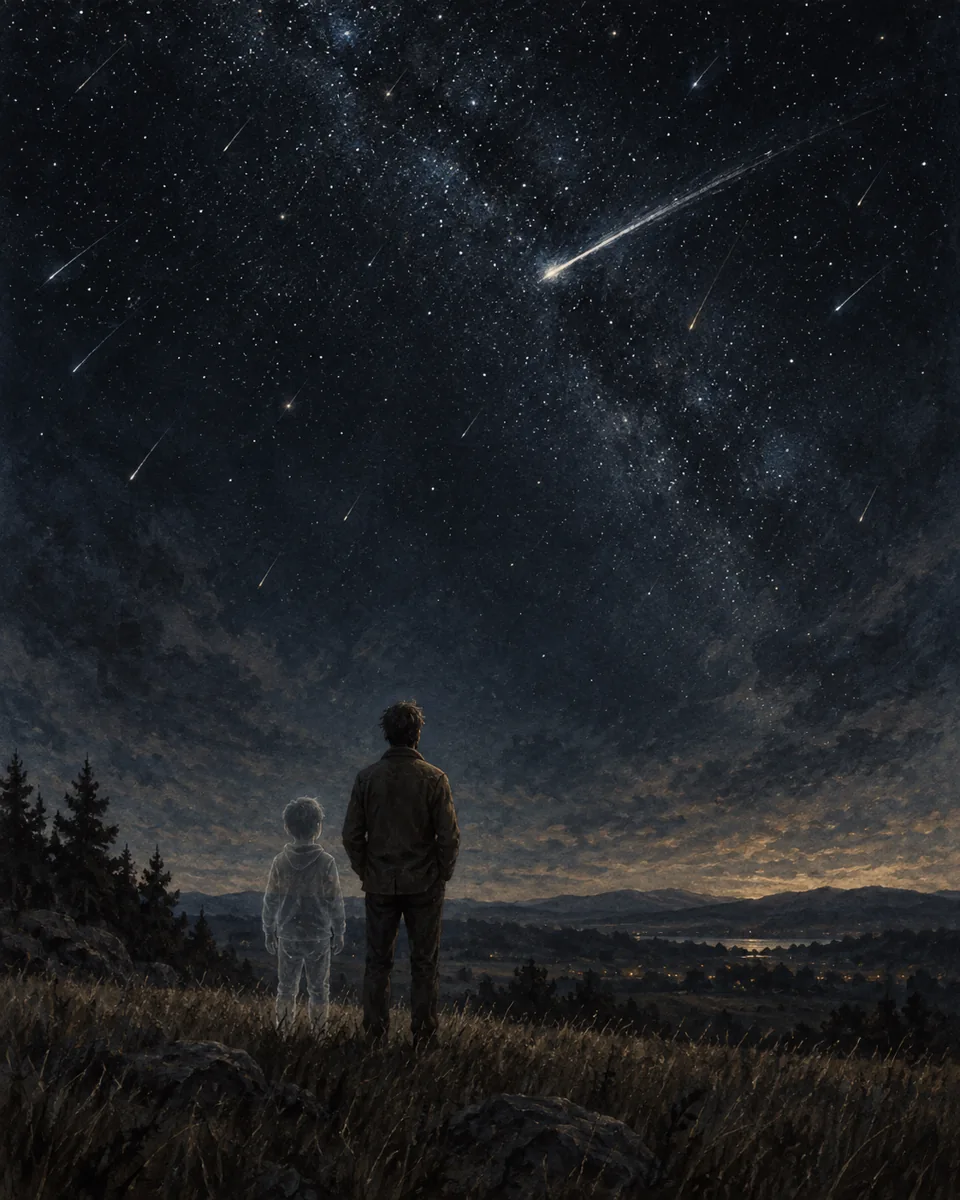
I have been thinking about grief beneath a meteor shower.
Which sounds poetic.
Almost too poetic, really.
As if grief becomes more beautiful when you place it beneath enough stars.
As if the universe casts some silver light across what hurts and suddenly we understand why it happened.
We don’t.
At least I don’t.
I have spent years sitting beside grief—
professionally.
Personally.
Spiritually.
And I remain suspicious of anything that tries to make it beautiful too quickly.
I once took pride in calling myself a thanatologist—
studying the processes of death and dying,
eventually becoming something of a death doula to the stars of the Hollywood Hills.
And I built such a relationship with grief that I came to know its face.
Its breath.
Its smell.
Its strange afterglow.
But my education began long before any classroom.
My own childhood taught me.
The rejected child in the hospital.
The loss of homes.
The slow loss of a mother’s mind—
and, in so many ways, her love.
The loss of dreams.
Of beliefs.
And once again, I hear Elizabeth Bishop’s One Art—
the practice of losing,
and the terrible art of grief.
Some things are simply devastating.
Some losses do not reveal a hidden purpose.
Some fires are not sacred.
Sometimes the person is gone.
Sometimes the home is rubble.
Sometimes the diagnosis comes.
Sometimes the relationship ends.
Sometimes the thing you prayed would not happen—
happens.
And no amount of meaning-making changes the fact that you would still give almost anything to have it otherwise.
This is where radical acceptance usually enters the conversation.
A phrase I have taught countless times.
A phrase I have sometimes wanted to throw directly through a window.
Because radical acceptance does not mean liking what happened.
It does not mean approving of it.
It does not mean everything happens for a reason—
or that you must hurry toward gratitude while your heart is still trying to understand the shape of the crater.
It means only this:
This is what is here.
This grief.
This fear.
This unbearable tenderness.
This life I did not ask for—
and must somehow decide how to live.
There is another practice called Opposite Action to Emotion.
The name is not especially poetic.
DBT occasionally sounds as if it were written by people who have never once needed to fit a therapeutic concept onto an inspirational coffee mug.
But the practice has saved me more than once.
When grief says—
close the curtains,
cancel everything,
curl inward,
stop reaching,
stop believing,
stop looking up—
Opposite Action asks whether I might open the door.
Not because the grief is gone.
Because it isn’t.
Not because joy has defeated it.
Because it hasn’t.
But because grief does not get to make every decision simply because it is currently the loudest voice in the room.
Sometimes Opposite Action is enormous.
Getting out of bed.
Calling someone.
Allowing yourself to be held.
Choosing not to leave before you are left.
Sometimes it is almost imperceptibly small.
Unclenching the hands.
Lowering the shoulders.
Taking one breath all the way in.
Letting the corners of the mouth turn upward in what DBT calls a Half Smile—
not a performance of happiness,
not a denial of pain,
just the body whispering to the nervous system:
There may still be something here besides danger.
I remember being a child and hearing Diana Ross sing at the end of The Land Before Time.
Littlefoot had lost his mother.
He kept walking.
Not because he no longer loved her.
Not because the loss had stopped hurting.
He walked because love had become something he carried.
I don’t think I understood that then.
I think some part of me simply recognized it.
The way children sometimes recognize truths long before they have language for them.
Grief and love are not opposites.
Grief is one of the places love goes when it can no longer return to its familiar form.
And perhaps hope is not the opposite of grief either.
Perhaps hope is what sometimes sits beside it.
Quietly.
Without trying to fix anything.
Without insisting on sunrise.
Just holding a small lantern while grief learns the geography of this new and unwanted world.
Years later, beneath the Lyrid meteor shower, I found myself looking up.
The sky was mostly dark.
That detail feels important.
A meteor shower is not a sky without darkness.
It is darkness interrupted.
A sudden line of light.
Then another.
Evidence that something can burn as it falls and still become beautiful to witness.
Although even that metaphor requires care.
Because I do not believe we have to call the burning beautiful.
I do not believe trauma made us stronger.
I do not believe loss was sent to teach us.
I believe we became strong because we had to survive what should never have happened.
I believe whatever beauty came afterward belongs to us—
not to the fire.
And still—
there I was.
Looking up.
Waiting for light.
One shooting star.
Then another.
And for a few breaths, joy stood beside grief.
Love stood beside fear.
Hope stood beside everything I knew could still go wrong.
No one had to leave.
That may be the strangest lesson of healing.
We are so often taught that happiness arrives when sadness ends.
That hope begins where fear stops.
That loving life again somehow betrays what we lost.
My mind drifts back to The Land Before Time—
and to the words Littlefoot’s mother left behind to carry him through his own journey with grief:
Listen to your heart.
It whispers—
so listen closely.
If only it were always that simple.
Yes, the heart whispers.
But sometimes it shouts and stamps its feet.
Sometimes it hides.
Sometimes it becomes completely quiet.
Sometimes it seems to leave altogether.
And there may be little rhyme or reason to when—
or why.
Perhaps listening to the heart does not mean expecting it to speak clearly.
Perhaps it means remaining near enough to hear it—
whatever voice it uses.
The whisper.
The wail.
The silence.
The small, almost imperceptible beat that says:
I am still here.
Because the heart is not a room with only one chair.
It can hold the child who is still crying—
and the adult standing beneath a meteor shower.
It can ache for what is gone—
and feel wonder for what remains.
It can know exactly how cruel this world can be—
and still turn its face toward the stars.
That night did not cure me of grief.
The meteors did not answer my questions.
The universe did not lean down and explain itself.
Morning arrived with the same losses.
The same uncertainty.
The same unfinished life.
But something in me had moved.
Not away from grief.
Toward the rest of me.
Toward breath.
Toward connection.
Toward the possibility that sorrow could be true without becoming the only truth.
Perhaps that is what I mean now when I say:
Live believing.
Not live certain.
Not live unafraid.
Not live pretending terrible things do not happen.
Live believing that fear does not get to be the only storyteller.
Live believing that grief can come with you without being asked to lead.
Live believing that one green thing can grow through ash.
That a heart can break and remain a heart.
That the night can be almost entirely dark—
and still contain a place where the light enters.
So if grief tells you to stop looking—
look up.
If it tells you that joy would be a betrayal—
let yourself smile when something beautiful finds you.
If it tells you to disappear—
take one breath.
Make one call.
Open one curtain.
Stand beneath whatever sky is above you.
You do not have to feel hopeful first.
Sometimes the action comes before the feeling.
Sometimes we practice our way toward hope.
One breath.
One Half Smile.
One impossible star at a time.
And perhaps belief is not the certainty that our dreams will never die.
Perhaps belief is more tender than that.
More honest.
Perhaps it is simply the decision to keep weaving them—
even here.
Even now.
Even beneath all this darkness.
To grieve.
To love.
To look up.
To live believing.