THE BOY WITHOUT A STAR
On Hunger, Belonging, and the Loneliness of Crowds
CJ Sterling | The Light We Leave On
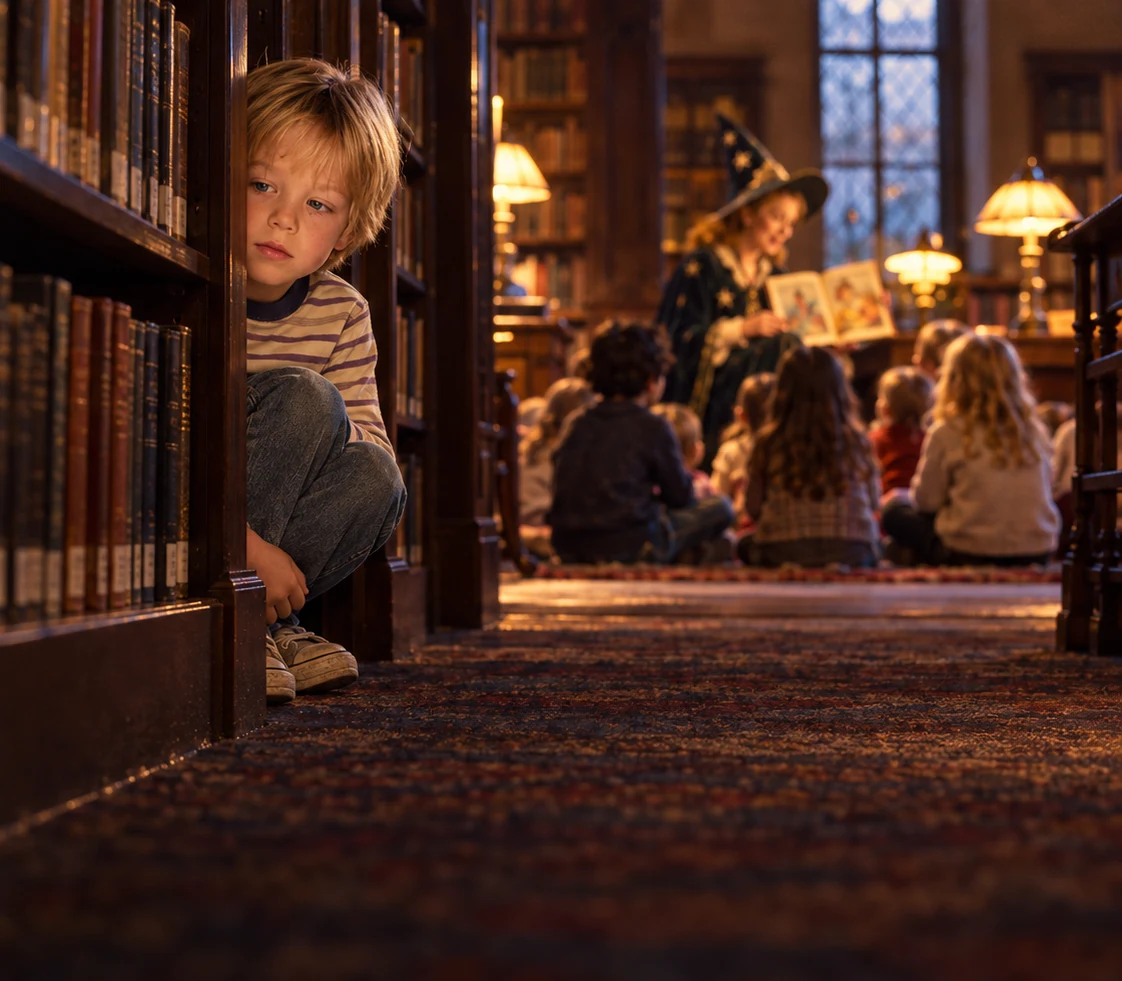
I remember the Sneetches.
Not because of the stars upon their bellies, or the ones who had none. Not because of the peculiar machine that could give you a star or take one away.
I remember the hunger.
And the woman dressed in a costume, sitting in the public library, reading to a gathering of children.
I remember the sound of her voice.
And I remember where I sat.
Behind the books.
Not with the other children. Not among the little bodies gathered together on the floor, their knees touching, their faces lifted toward someone who had come to tell them a story.
Behind them.
Where I could hear everything without having to be seen.
I was a little blonde boy, and I was hungry again.
My mother sometimes used the library as a place to leave us. Other times, she sent us out into the world to find something to eat, or simply to be somewhere else. Somewhere we wouldn’t be in the way.
And so I became acquainted with crowds long before I understood what they were doing to me.
I knew the sound of people walking past.
The movement of coats and shoes. The smell of food. The sudden laughter of strangers. The way a crowd could part around a small child without ever seeming to notice he was there.
But more than anything, I knew what it looked like when people belonged to one another.
A father carrying a child on his shoulders.
A little girl crying, and her mother reaching down without hesitation.
Two people holding hands.
A family deciding where they would eat.
Such ordinary things.
I watched them as though they were miracles.
And perhaps they were.
Because I could not understand how something that seemed so effortless for everyone else could be so impossibly far away from me.
I remember wanting someone to notice.
Not necessarily to rescue me. I didn’t have the language for rescue.
I wanted someone to look at me the way those parents looked at their children.
To recognize me.
To wonder whether I was hungry.
To ask where I belonged.
When I was very small, people sometimes did ask whether I was lost. Where my parents were. Whether I was all right.
But those questions stopped coming.
I don’t remember exactly when.
Perhaps I grew old enough to look as though I knew where I was going. Perhaps I learned to carry myself with a confidence I didn’t possess. Perhaps the world simply became accustomed to seeing children who appeared to be managing.
Whatever the reason, people stopped asking.
And I learned to smile.
I learned to move through crowds without attracting concern. I learned that a pleasant expression could answer questions before anyone thought to ask them.
I became very good at appearing as though I belonged somewhere.
Even when I didn’t know where that somewhere was.
⸻
That afternoon in the library, the woman read about creatures with stars on their bellies and creatures without them.
And I understood something that made me cry.
The world was full of Sneetches.
People who belonged to groups. People who recognized one another. People who had families and friends and places where they were expected.
Some had stars.
Some had plain bellies.
But both kinds belonged to a world in which someone knew what they were.
I looked down at my own belly.
And in my imagination, there was neither a star nor a plain patch of skin.
There was a void.
Not because I was hungry.
Although I was.
There was a different hunger beneath that one.
A hollow place where belonging should have lived.
And I remember grieving.
Not simply because the story was sad. Not because the illustrations frightened me.
I grieved because I understood the story differently from the children sitting together on the floor.
I wasn’t wondering how to get a star.
I was wondering what happened to the ones who didn’t belong to either group.
The ones nobody thought to include.
The ones who couldn’t even pretend.
I sat behind those books and cried.
And the story continued.
⸻
I grew older.
The little blonde boy became a teenager, and then a man.
I learned how to enter rooms.
How to shake hands. How to smile. How to make conversation. How to make other people feel comfortable.
I became someone who could stand before a crowd and appear entirely at ease.

And sometimes I was.
But there was another experience happening beneath the surface.
One that never seemed to grow older in quite the same way I did.
I could walk into a crowded room and feel the ache begin before anyone had spoken to me.
I would see a couple leaning toward each other in conversation.
A father resting his hand on his son’s shoulder.
Someone laughing with a friend who knew the story behind the laughter.
A child running toward a familiar pair of arms.
And something inside me would reach toward them.
Not because I wanted to take their happiness away.
Quite the opposite.
I loved seeing it.
And that was part of what made it hurt.
I could recognize tenderness everywhere.
I could feel its beauty.
And I could feel the distance between witnessing it and receiving it.
I have often thought of myself as a Betazoid.
Not literally, of course.
But I remember watching Deanna Troi on Star Trek: The Next Generation and feeling something extraordinary.
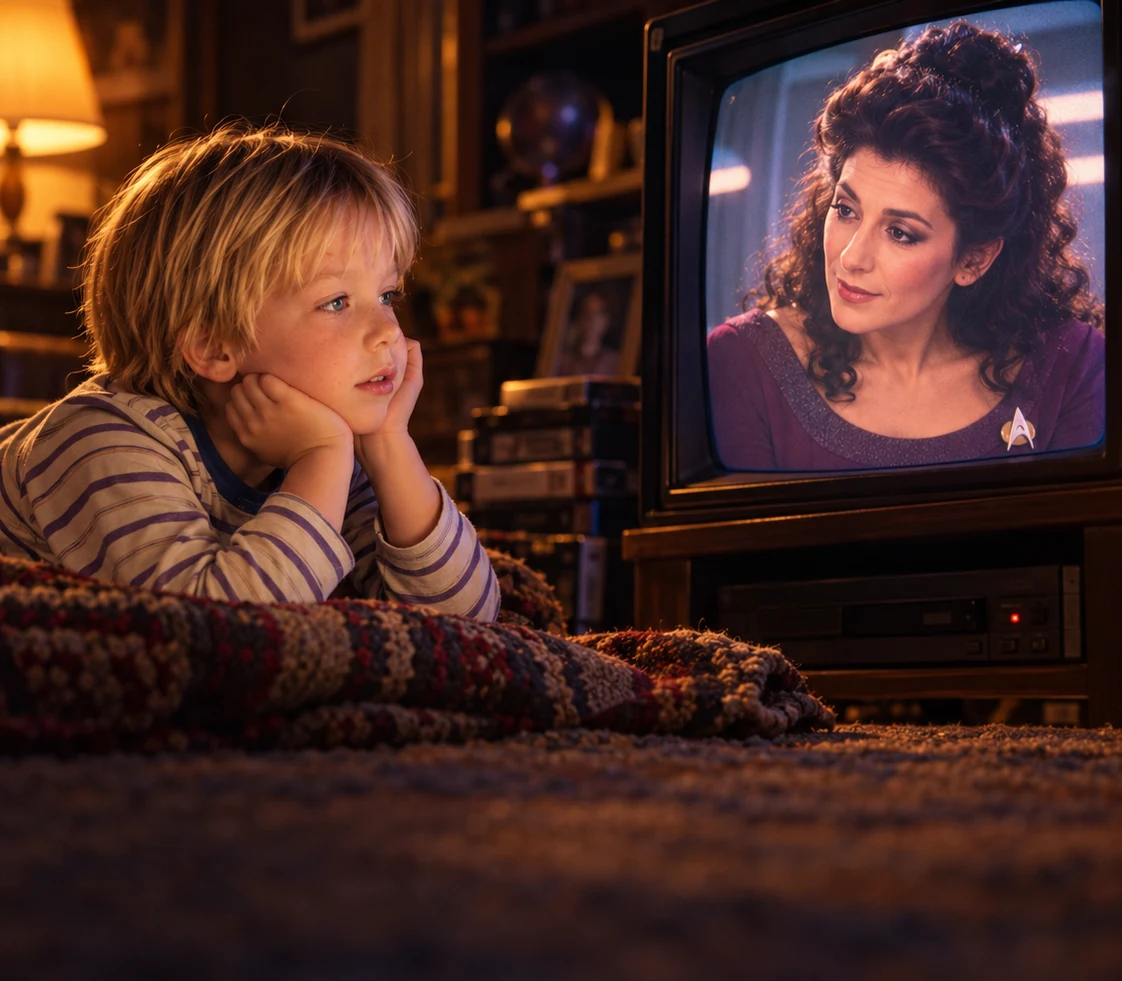
Recognition.
Here was someone whose sensitivity was not treated as a shameful defect.
She could enter a room and perceive emotional currents that others overlooked. She could recognize distress beneath composure, fear beneath anger, tenderness beneath restraint.
And she didn’t need to become less sensitive to be worthy of her place.
Her sensitivity belonged to her.
It was part of who she was.
I had spent so much of my childhood being taught that my feelings were excessive. That my sensitivity was something to correct, conceal, or apologize for.
Even the adults who were supposed to help me sometimes managed to turn it into another source of shame.
But Deanna didn’t need fixing.
She simply was.
And watching her gave me a way to understand something about myself that I had never been able to explain.
I didn’t merely see the world around me.
I felt my responses to it with extraordinary intensity.
The joy.
The sorrow.
The loneliness.
The tenderness.
All of it.
And crowds became especially difficult because there was so much happening outside me and so much being awakened inside me.
A thousand faces.
A thousand gestures.
A thousand small reminders of the things I had wanted since childhood.
And somewhere among them, the little boy behind the bookshelves.
Still listening.
Still watching.
Still hoping someone might notice.
⸻
People sometimes misunderstand why I struggle with crowds.
They imagine I dislike people.
And sometimes, admittedly, I say that I do.
It’s easier.
It’s easier to say I hate crowds than to explain that I can feel terribly lonely in the middle of one.
Easier to say there are too many people than to explain that there are too many reminders.
Too many fathers lifting their children.
Too many mothers reaching for small hands.
Too many people who seem to know instinctively where they belong.
And there is the physical experience, too.
The noise. The movement. The overlapping conversations. The lights. The constant awareness of bodies passing close to mine.
My nervous system can become overwhelmed by it all.
But beneath the sensory experience lives something older.
A longing that has never entirely quieted.
And perhaps the most difficult thing to admit is that I still sometimes imagine someone noticing.
Even now.
At my age.
Some part of me still imagines a person looking across a crowded room, seeing past the practiced smile and the capable adult, and recognizing the child who has been searching for somewhere to belong.
I know how unlikely that sounds.
I know I am no longer a little boy whom someone might gently take by the hand and lead home.
But the longing doesn’t consult a calendar.
It doesn’t disappear because the body grows taller or the face becomes older.
It simply grows alongside you.
And sometimes the ache becomes greater because there are more years inside it.
More crowds.
More faces.
More moments of watching someone else receive the ordinary tenderness you once hoped might find you.
⸻
Recently, something unexpected happened.
I made a little film.
It was about a blonde boy sitting in the captain’s chair of the Enterprise, remembering Jean-Luc Picard, the man who helped him imagine a better world and a better man.
And people began watching.
Then sharing.
Then writing.
Strangers told me about their own childhoods. Their own heroes. The fictional people who had helped them survive difficult years, understand themselves, or imagine lives beyond the ones they knew.
And I found myself reading their words with an emotion I hadn’t anticipated.
Recognition.
Here were people who understood why a fictional starship captain could mean something so deeply personal.
People who understood that stories sometimes reach children in places where adults have failed to reach them.
People who had carried these characters through decades of their lives, just as I had.
And for a moment, I wondered something.
What if I went to a convention?
A room filled with people who loved the same stories.
People who remembered the same characters.
People who might understand why a little boy had once found companionship among the stars.
The thought frightened me almost immediately.
A crowd.
Of all things.
After a lifetime of avoiding them, I was considering walking willingly into one.
And I recognized the irony.
The boy who had spent his childhood looking for somewhere to belong was now a man considering entering a crowd because he wondered whether belonging might be waiting there.
I don’t know whether I’ll go.
I don’t know whether I’ll find what I’m looking for.
Perhaps I’ll become overwhelmed and leave after an hour.
Perhaps I’ll stand at the edge of a room, smiling politely, while the old ache rises again.
Perhaps I’ll find myself watching people who already know one another and feel like the little boy behind the bookshelves.
I won’t pretend that possibility doesn’t frighten me.
But perhaps I’ll meet someone who remembers Spock the way I do.
Someone who understands why Deanna Troi mattered.
Someone who knows what it means to have found a family of sorts aboard a fictional starship.
Perhaps we’ll talk.
Perhaps we’ll laugh.
Perhaps, for a few minutes, I won’t feel quite so far away from everyone else.
I don’t need to imagine anything grander than that.
⸻
I have thought often about the Sneetches since that afternoon in the library.
About the stars and the plain bellies.
About the strange machinery people build to decide who belongs and who does not.
But mostly I remember the little boy who couldn’t find himself in either group.
The one who sat behind the books because sitting with the other children seemed like something that belonged to another world.
I wish I could tell him that the ache disappeared.
That one day he grew up and crowds became easy.
That the world eventually made room for him without his having to ask.
But I cannot tell him those things.
They would not be true.
What I can tell him is that he grew up and found ways to give language to the things he felt.
That he made art.
That he wrote stories.
That he discovered other people who had spent their childhoods looking toward the same stars.
And that somewhere along the way, he began to wonder whether he might try entering the crowd again.
Not to earn a star.
Not to become a different kind of Sneetch.
Not to prove that he deserved a place among them.
Simply to see whether someone might be there who understood.
I still carry that little boy.
I carry his hunger.
His tenderness.
His extraordinary capacity to feel.
And the ache that sometimes makes a crowded room feel like the loneliest place in the universe.
I don’t know whether that ache will ever entirely leave me.
But perhaps there is something I can do now that I couldn’t do then.
I can choose which crowds I enter.
I can leave when I need to.
And I can look for people whose presence feels less like another reminder of what I’ve missed and more like an invitation to share something.
I may still stand at the edge.
I may still be frightened.
And some part of me may always hope that someone will look across the room and notice.
Not the smile.
Not the man who seems to have everything under control.
But the little blonde boy who has been waiting such a very long time.
And perhaps, one day, someone will.
Not because I have a star upon my belly.
Not because I’ve finally learned how to belong to the right group.
But simply because they see me.
And there is room beside them.
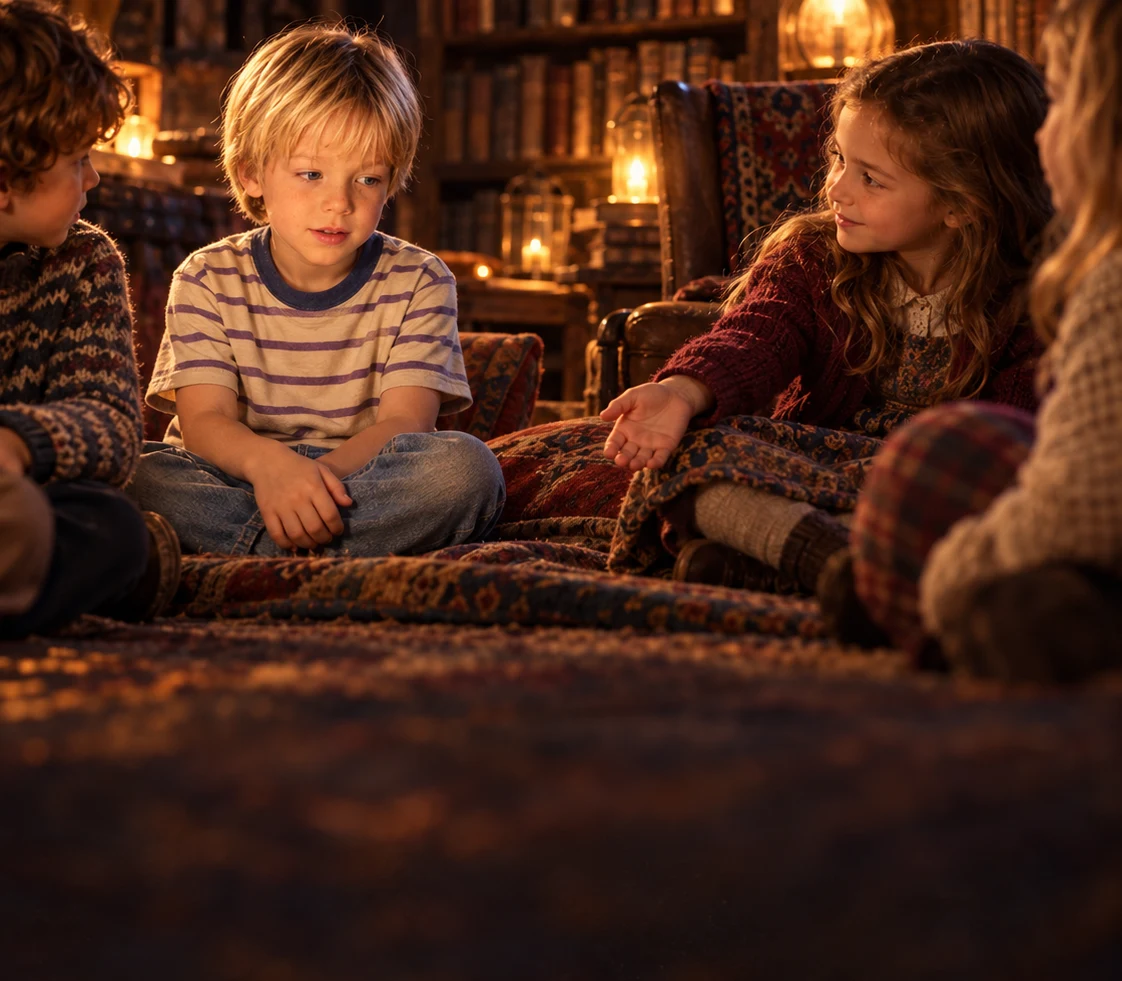
Perhaps that is all I ever wanted.
Not a star.
Not a machine to make me like everyone else.
Just someone who would move over a little.
And say,
Come sit with us.
⸻
The Light We Leave On
CJ Sterling