The Rooms We Reach After No One Intervenes
I have been thinking about the rooms we reach after no one intervenes.
The choir room.
The car.
The tiny room that belonged to Waverly during the last year of her life.
Rooms we enter only after proving we can cross the distance alone.
Perhaps that is where this story begins.
Or perhaps it begins at the bottom of a staircase—
with a child who had just been thrown down it while someone called him queer.
I remember the broken rib.
But strangely, the broken rib was not the part that hurt most.
Pain was almost simple.
Pain had instructions.
Stand up.
Do not make a sound.
Pretend you are not in agony.
Limp toward the choir room.
Collapse only after the door closes.
My body already knew how to do that.
What I did not know how to understand were the faces around me.
The people I thought were friends.
They saw.
They heard.
And then they looked down.
Nobody said anything.
Nobody came toward me.
Nobody placed themselves between the injured child and the world that had decided he could be injured publicly.
And perhaps this is one of the earliest rules my body learned—
if you can still stand,
people will assume you do not need help getting up.
Years later, there was another room.
This one was in South Africa.
A wonderfully ordinary little lunch place during one of the teaching seminars my mentor and I were leading.
Teaching seminars I had helped create.
Programs I had helped write.
Entire bodies of work shaped through my mind, my experience, my language—
often without my name attached.
I did not argue.
Of course I didn’t.
Who was I to do that?
And what if speaking up affected the mission?
What if it diminished the work?
What if it prevented her from being successful and helping other people?
Everyone else mattered more.
That was not merely a belief.
It was practically a professional ethic.
At the restaurant, there was a waiter who spoke only a little English, but whose personality was so bright that language hardly seemed necessary.
He kept walking by our table and looking at me.
At one point he pointed me out to his colleagues.
Finally, he came over.
“Who are you?” he asked.
“You must be someone special.”
I turned red.
I told him I was just me.
I explained that we were a group of trauma specialists visiting from America.
But he shook his head.
“No,” he said.
“You are someone special.”
He returned a second time.
Perhaps a third.
Still smiling.
Still carrying none of the flirtation or sexualization I had learned to expect when someone looked at me too long.
There was something almost innocent in him.
Pure.
He took my arm and asked me to stand.
Then he told me to go stand in the corner.
The corner.
An unfortunate choice for a child formed inside Southern Baptist punishment.
But I could tell that was not what he meant.
So I asked him why.
“Because you are so bright and full of light,” he said.
“We could stand you in this corner and you would brighten the whole restaurant.”
“You must be someone special.”
And something happened inside my body.
Not an idea.
Not a pleasant reaction to a compliment.
Something anatomical.
It began in my stomach like an electrical current and started rising through me.
I knew that feeling.
I had spent years watching it move through other people.
The strange tingling arrival of something that had been trapped finally finding a path.
Trauma resolving itself not as explanation—
but movement.
The current rose.
Past my stomach.
Into my chest.
Almost to my heart.
Almost.
And then—
BAM.
“He’s no one special.”
My mentor had stood up.
She pointed her finger down at the table as though the waiter needed to be corrected.
“He’s no one special.”
Tap.
“We are all clinicians here.”
Tap.
Tap.
And with every strike of her finger, I felt the current reverse.
It crawled back down through my chest.
Back toward my stomach.
Back into whatever hidden place had released it too soon.
The light extinguished before it reached my heart.
But even then, I did not look toward myself.
I looked at the waiter.
I watched the surprise move across his face.
Then the confusion.
Then the flush of shame.
His entire visage changed.
He had offered something sweet and unguarded, and suddenly he had been publicly corrected for seeing what he saw.
So I felt sad for him.
Of course I did.
Something had just been wounded inside me, but my attention went immediately to the other person in the room who might need care.
I had become very good at that.
What I understand differently now is that we were not alone at the table.
Some of my favorite people were there.
Extraordinary clinicians.
Healers.
Friends who knew different parts of the broken boy inside me.
A breathworker I adored for her fierce commitment to justice—for the way she demanded that her clients be seen and protected.
People with the skill to recognize shame while it was happening.
People who had used their voices for clients and loved ones even while afraid.
They heard every word.
They saw my mentor standing.
They saw the finger strike the table.
They watched the waiter’s face change.
They knew me.
And nobody said anything.
They looked down.
Perhaps they were intimidated.
Most people were intimidated by her.
Perhaps they thought I could handle it.
And maybe that is another rule I learned—
if you become sufficiently skilled at surviving harm,
people begin to mistake that skill for permission not to protect you.
Christopher understands.
Christopher can regulate himself.
Christopher will be okay.
Christopher does not need us to risk anything.
His strength will cover our silence.
Years before that restaurant, there had been another absence.
Graduation.
I had been working more than sixty hours a week while being paid less than minimum wage in the same program connected to this mentor.
Graduation would have cost approximately four hundred dollars.
I could technically have paid it.
But there were groceries.
Bills.
The small, unremarkable expenses of remaining alive.
And at the end of that calculation was another truth—
no one would have come.
My mother was already disappearing into the private world of her illness.
My siblings had left to build lives away from the reminders of what we had survived.
My father remained mostly absent.
I have never particularly needed applause.
Ego and praise have never interested me much.
So I told myself there was no practical reason to spend money I needed in order to cross a stage for no one.
I did not go.
Later, a colleague told me what happened when the class noticed my absence.
They scoffed.
And a teacher—
the teacher—
announced that Christopher thought he was too good to attend graduation with everyone else.
It is strange to realize now that perhaps I did care.
Perhaps the young man working sixty hours a week would have walked toward that stage and felt every empty seat become real.
Knowing nobody would be there is one kind of loneliness.
Walking into an auditorium full of other people’s witnesses is another.
Names called.
Families cheering.
Cameras raised.
People standing because someone they loved had arrived at a threshold.
And then my name.
Perhaps my body would have searched anyway.
The body does that.
It looks for the mother who is already gone.
The father who has mostly remained absent.
The siblings who had to escape.
Perhaps I would have smiled.
Accepted the diploma.
Performed composure beautifully.
Then carried the knowledge home—
I graduated.
It happened.
And no one saw me do it.
Maybe I did not stay away because I believed I was too good for the room.
Maybe I stayed away because I could not afford four hundred dollars to have my loneliness enlarged to the size of an auditorium.
And still—
the institution took my protection and renamed it arrogance.
There appears to have been no acceptable size for me.
When I was visibly bright—
“He’s no one special.”
When I quietly disappeared—
“He thinks he’s too special.”
When I contained my suffering—
“He can handle it.”
When I revealed it—
“He’s too much.”
When I asked for nothing—
“He doesn’t need us.”
And when the need finally became visible—
people looked down.
Years later, my mother died.
I grieved her with control.
By then I was a clinician.
A very good one.
I understood nervous systems, containment, radical acceptance, grief, trauma, adaptation, post-traumatic growth.
I knew how to keep the gate.
And then Waverly died…
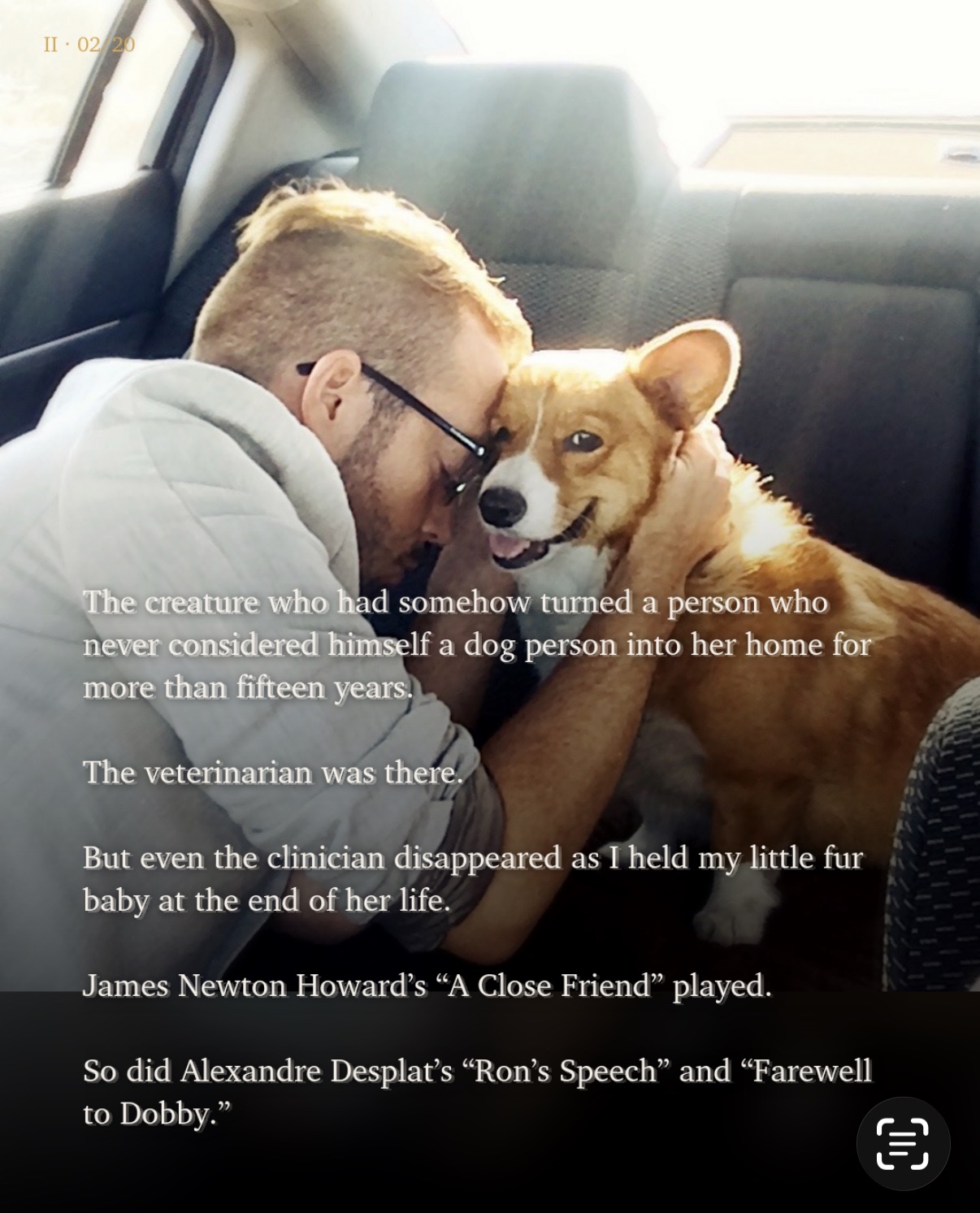
My miraculous little corgi.
My little pig.
The creature who had somehow turned a person who never considered himself a dog person into her home for more than fifteen years.
The veterinarian was there.
But even the clinician disappeared as I held my little fur baby at the end of her life.
James Newton Howard’s “A Close Friend” played.
So did Alexandre Desplat’s “Ron’s Speech” and “Farewell to Dobby.”
Again.
And again.
For days, perhaps.
May you be well.
May you be happy.
May you be free from suffering and pain.
May you come home—
to the light.
I liberated her with love.
And afterward, I did not go to the car.
I went into the tiny room that had belonged to Waverly during the last year of her life.
A room scarcely larger than a cupboard.
I lay down inside the physical shape of her absence.
The music played.
And I wept.
Not the clinician’s grief.
Not the dignified grief of a strong man who understands the process.
Not grief translated into language quickly enough to make everyone else comfortable.
I wept with my body.
And perhaps that little room became something more than a room.
A den.
A womb.
A cupboard-sized chapel.
I went there because love still smelled like home.
My partner at the time was Anthony.
An entertainer and singer—
yes, I know. Cliché.
We had traveled the entire Pacific together.
He had witnessed the controlled grief surrounding my mother’s death the year before.
But after seeing me grieve Waverly, he told me that he could not understand my process.
That he could not look at me the same way.
That he could no longer see me as the strong man he had known.
He left the next day.
He never returned.
Not even for his things.
And somehow I do not think I grieved Anthony then.
Perhaps I grieved him a year later.
Perhaps I never fully did.
There may not have been enough room inside me for another loss.
Or perhaps the gatekeeper moved too quickly.
Closed everything.
Locked the doors.
Turned him from someone I loved into evidence.
If they see all of it, they leave.
If the gatekeeper abandons his post, everyone leaves him.
He’s no one special.
Why would anyone remain for his grief?
Anthony was the last relationship I attempted for a very long time.
Not because I had stopped loving.
I loved everywhere.
I loved clients.
Animals.
Music.
Stories.
Strangers.
People across oceans moving through pain and injustice.
But after Anthony, some part of me shut off.
Protected.
Went deeper within.
I remained single.
I simply stopped letting romantic love near the room.
Until, many years later—
some part of me began to open the door again.
And something else happened after Waverly.
I stopped being able to help people.
That is not quite right.
I did not lose the expertise.
I did not lose the skills.
I did not stop caring.
But I was done.
Or lost.
Or something different altogether.
Like butter spread too thin across toast.
Like the Skin Horse in The Velveteen Rabbit—
so old that his brown coat had gone bald in patches, his seams showing, most of the hair from his tail pulled out to make bead necklaces.
Nothing dramatic had to break.
There was simply no part of him that had not already been used in the service of love.
I had spent fifteen years sitting beside people in their burned places.
I had learned all the beautiful clinical words.
I had taught them.
Written programs around them.
Built rooms where suffering could be witnessed safely.
But perhaps I had become unable to keep disappearing inside the act of helping other people.
Perhaps the clinician did not die when Waverly died.
Perhaps the contract did.
I began decreasing my caseload.
Quietly.
Gradually.
Making my way toward retirement before I had language for why.
About a year later, as COVID began, I closed my practice.
From the outside it may have looked like timing.
A professional transition occurring alongside a world event.
But perhaps the practice had already begun closing inside Waverly’s little room.
Perhaps the part of me that had always said—
I’ll carry it.
Someone else needs help more.
My grief can wait.
—could no longer sign his name.
And perhaps this entire story is about witnesses.
The classmates who looked down after the stairs.
The friends who did not come toward the injured child.
The clinicians at the table who understood shame professionally but could not challenge it personally.
The teacher who interpreted an empty chair without wondering what it had cost to leave it empty.
The mentor who took my words without my name, then tried to take the light from my body before it reached my heart.
Anthony, who witnessed grief without its armor and left.
And the waiter.
The bright, innocent waiter who knew almost nothing about me.
Who did not know what I had survived.
Who did not know what I had written.
Who did not know how useful I could be.
Who did not need me to teach him, regulate him, rescue him, forgive him, or make myself smaller so he could remain comfortable.
He simply looked at me.
Again.
And again.
As though something in him insisted upon recognition.
You are so bright and full of light.
You must be someone special.
My mentor did not create the light.
She did not extinguish it either.
She frightened it back into hiding.
There is a difference.
It survived in every room where someone felt safer because I was there.
In every person who found language for something they had carried alone.
In the program even after my name was removed.
In the animals who trusted my arms.
In the music that held Waverly after my body no longer could.
In the stories that kept forming even after I believed I was done.
And now—
in the terrifying, imperfect practice of allowing myself to love out loud again.
Perhaps that is why being seen still enters my body like electricity.
Why love can feel like light and danger moving through the same anatomy.
Why some part of me still waits for the finger against the table.
Why silence can become a staircase.
Why distance can become an empty auditorium.
Why grief still wonders whether it must hide before everyone leaves.
But I am beginning to understand something.
My strength was never consent to leave me unprotected.
My competence was never proof that I did not need care.
My ability to stand was never evidence that being thrown did not hurt.
And my grief was never a failure of manhood.
I was a boy who deserved someone at the bottom of the stairs.
A young man who deserved one face in the audience.
A clinician who deserved his name on the work he created.
A friend who deserved someone at the table to raise their head.
A grieving man who deserved a partner capable of remaining in the room.
Perhaps I am still learning what might have happened if somebody had said—
No.
He is.
He is someone special.
Not because he is useful.
Not because he can carry more than everyone else.
Not because he can survive what should never have happened.
Not because his light belongs to the room.
Simply because he is here.
I do not know yet what to do with that.
The current begins in my stomach.
It rises.
Slowly.
Almost to my heart.
And for now—
we let it.
No one strikes the table.
No one corrects the witness.
No one looks down.
This time,
we let the light arrive.
And in the particularly magical moments—
or perhaps the wonderfully ordinary ones—
we let it shine.