The Wild Things
Full disclosure—
when I was young, I didn’t know how to love.
Or feel, for that matter.
Having never really been taught, I understood only two settings—
all the way on
or all the way off.
Run directly toward it.
Or run like hell in the other direction.
There was no middle path.
No place where love and fear and longing and freedom might all sit at the same table without somebody having to leave.
Even then, I think I knew why.
That was what I had been shown.
And children are extraordinary students of the worlds we give them.
They learn the weather before they ever learn the names of the storms.
One day my mother caught me standing outside in a thunderstorm.
I had always loved storms.
The darker the sky, the more alive some part of me became.
Apparently my mother decided this was a fixation requiring intervention.
So naturally—
because my family has never understood the concept of moderation—
she drove us toward a tornado.
I imagine now that she was trying to teach me fear.
But fear was something I already knew how to digest.
So did she.
And somewhere near the center of that storm, the rain and hail suddenly stopped.
There was only wind.
That strange terrible stillness around something enormously powerful.
And the two of us stood there—
with approximately nothing between us and a tornado except our untamed egos—
completely unafraid.
Wild recognizing wild.
I have thought about that moment many times since.
Because despite the intention,
despite the danger,
despite all the physical and emotional space that so often existed between my mother and me—
it remains one of the closest moments I remember sharing with her.
For a moment neither of us had to pretend to be something else.
We were simply two wild things standing beside one another at the edge of something even wilder.
Maybe that’s why I spent so much of my early life loving beasts.
Whales.
Dolphins.
Cheetahs.
Rhinos.
Anything enormous or strange or endangered or impossible to domesticate.
At my fiercest, I would take money I made from sex work—money that was already helping feed my family—and send some of it away to adopt animals from those little mail-order catalogs.
Which, looking back, is such an extraordinarily specific expression of who I was.
Surviving.
Feeding people.
And apparently also financially responsible for a rhinoceros somewhere.
I didn’t think I was particularly good.
Certainly not altruistic.
I just remember carrying this strange certainty inside me—
someone must love these beasts more than this world they were made into.
And then there were the elephants.
A circus came to town.
And because subtlety had apparently still not found me,
I decided I was going to free them.
I cut holes in the elephant tents.
I pulled at the enormous augered stakes holding their lines.
Sweating.
Pulling.
Pleading with these magnificent creatures—
Run.
Go.
Be free.
And then a dear friend put a hand on my shoulder.
Not forcefully.
Just enough to interrupt the story happening inside my head.
And asked me a question.
But where would you release them?
Oh.
I can still feel that question almost twenty-eight years later.
Because there are moments when someone says twelve words to you and somehow an entire architecture inside you moves.
I thought love meant opening the gate.
Cut the rope.
Pull up the stake.
Break whatever is holding the beloved thing captive.
Run.
Freedom.
That was love.
And standing there beside those elephants, I encountered one of my first real dialectics.
Because sometimes love is opening the gate.
And sometimes love is understanding what waits on the other side.
Sometimes liberation without safety is simply another kind of abandonment.
Sometimes loving something fiercely means resisting the desperate urge to save it in the way you need saving to look.
Jesus.
That one took me a while.
Maybe it still is.
Because I have spent much of my life with some version of those wire cutters in my hand.
With people.
With animals.
With the world.
With myself.
Let me get you out.
Let me fix this.
Let me make somewhere safe.
Let me love you hard enough that whatever has you cannot possibly keep you.
There is something beautiful in that impulse.
There is also something frightened.
And sometimes those two things are living in exactly the same place.
That may be one of the hardest things I have learned about love.
Fierceness and fear can wear each other’s clothes.
The answer was never to stop being fierce.
God, no.
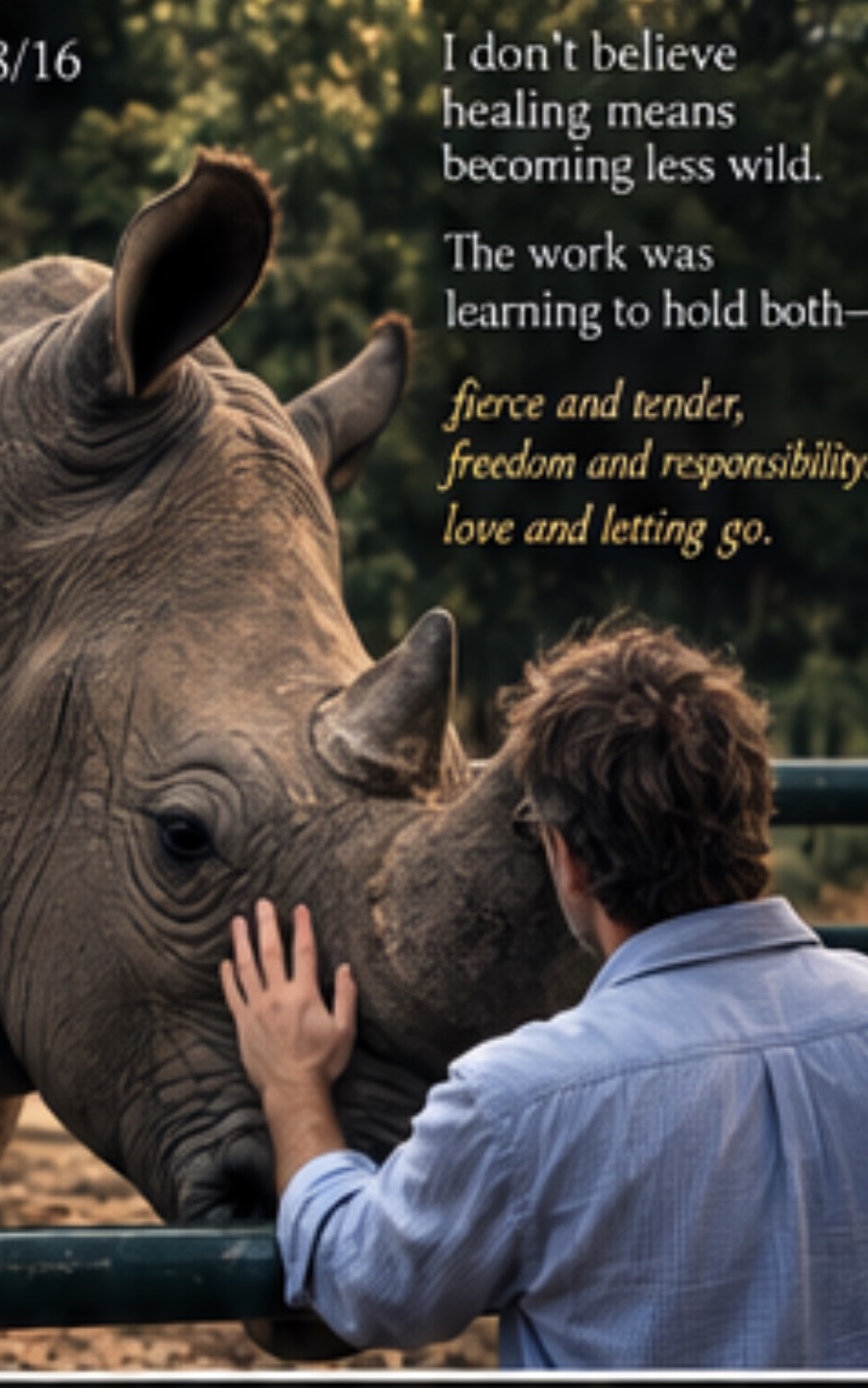
I spent enough of my life believing healing meant becoming less of myself.
Less intense.
Less sensitive.
Less wild.
Less much.
As though health were some beige room where nothing ever gets knocked over.
I don’t believe that anymore.
The middle path was never—
wild or safe.
Fierce or tender.
Freedom or belonging.
Love or letting go.
The work was learning to hold both.
Wild and safe.
Fierce and tender.
Freedom and responsibility.
Love that can open the gate—
and love that asks what happens afterward.
Maybe that’s part of what Pride has come to mean to me too.
Not simply being permitted to exist.
Not becoming acceptable enough to be loved.
Not sanding down every strange and inconvenient and beautiful edge until the world finally decides we are safe enough to welcome inside.
But learning to love what was once called too much.
The untamed.
The queer.
The frightened.
The sexual.
The grieving.
The ridiculous person trying to liberate elephants without having developed phase two of the plan.
The child standing in the storm.
The person who didn’t know how to love yet—
but God,
wanted to.
Maybe that is the part I feel most tenderly toward now.
Because I don’t think that younger version of me was broken in the way I once believed.
I think he was trying to build a language for love out of whatever materials he had been given.
Sometimes he built badly.
Sometimes beautifully.
Usually both.
Dialectics.
And perhaps that is why I still love the beasts.
The ones walking this earth.
The ones sitting across from me.
The ones I have loved.
And the ones inside myself.
Especially those.
Because somewhere along this journey I finally understood something I couldn’t have known standing beside those elephants all those years ago.
I thought I was always the one holding the wire cutters.
The one opening cages.
Pulling stakes.
Whispering—
Run.
Go.
Be free.
And maybe I was.
But my sweet boy—
you were one of the beasts too.
Wild.
Frightened.
Fierce enough to survive a world you hadn’t yet learned how to live inside.
Desperate to love something the way you needed to be loved.
And all these years later,
I came back for you too.
Not to tame you.
Not to make you smaller.
Not even to set you free.
Just to sit beside you long enough for you to discover
that you don’t have to run anymore.
Maybe that’s what Home was becoming all along.
So to the beasts—
the wild ones,
the wounded ones,
the magnificent ones,
the ones still pacing beside whatever fence somebody built around them—
I wish you well.
I wish you happy.
I wish you freedom from suffering.
Freedom from pain.
And above all,
I wish you the complete and wonderful awareness of your importance in this journey.
May you become Home.
May you become a Home for other journeyers, near and far.
And may you love the beast—
the untamed,
the wild,
the impossible thing inside you—
as fiercely as it always deserved to be loved.
Beyond your comprehension.
And when the gate finally opens,
may you know something I didn’t yet know standing beside those elephants all those years ago—
you don’t always have to run.
Sometimes freedom is discovering
you are already Home.